

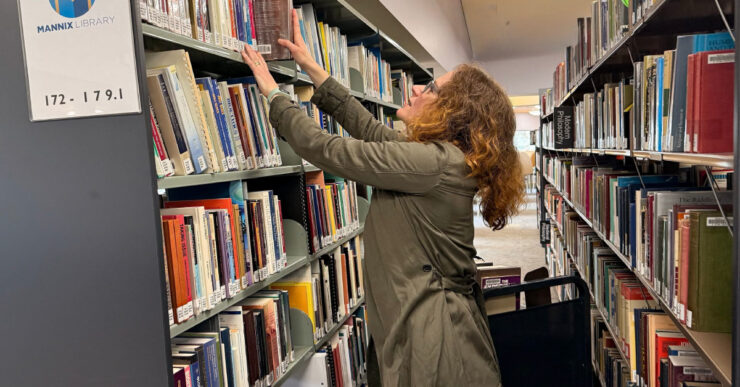
Mannix Library’s head librarian, Amy Isham, has spent much of her life around books. She is watching her profession change as readers contend with AI-generated content, algorithmically curated information and declining attention spans. Yet she remains hopeful that improving literacy will always be the core mission of a library.
We still consume text constantly, even when we are not sitting down with a book, says Amy. ‘If we’re not reading well-edited, well-thought-through texts, then it’s harder to discern whether that TikTok reel is just made up or someone’s heavily biased take.’
This is where librarians come into their own, imparting their knowledge of what makes a good book, or how to discern bias.
‘Librarians are trained to help you with your information needs,’ Amy says. ‘If someone says, “I’m doing my capstone study in Mark’s Gospel, and it needs to be a critical reading. I don’t know where to start,” you can say, “Why are you doing that? Why are you interested in that?”.
‘I really enjoy pulling out why is someone doing something and how can I fulfill their need. It may not be what they actually think they’re looking for.’
Libraries themselves remain indispensable. They are repositories of books—including e-books and audiobooks—but they are also training grounds for critical thinking.
That starts with ‘library literacy’, which Amy teaches many students walking through the doors of Mannix Library for the first time. ‘Some of them haven’t even used a library before,’ Amy says, explaining that they will simply ask the librarian to fetch books for them.
Rather than doing that, Amy says she shows them how to use the catalogue and Dewey Decimal System, how to write effective search prompts and how to email themselves e-book links.
‘You need to learn how to navigate a library,’ she says. ‘You need to learn how to write a prompt in a search engine.’
Mannix Library users are mostly students of Catholic Theological College and the University of Divinity, and other university students who value the peaceful and studious atmosphere. Anyone is welcome to use the space, with a modest annual membership fee for those who want to borrow books.
The books in most demand relate to the library’s areas of specialisation—theology, philosophy, biblical studies. But there is a growing demand for Catholic fiction, which Amy attributes, at least in part, to Pope Francis’ encouragement.
In his 2024 Letter on the Role of Literature in Formation, Pope Francis said that reading novels and poems contributes to personal maturity and helps people encounter ‘another person’s voice.’ Literature, he wrote, can develop imagination, creativity, concentration, and empathy (§8-9).
Amy describes this as ‘creative literacy’—the capacity to understand another person’s perspective through story.
‘You can understand the divorcee or the person that doesn’t have faith,’ she says. ‘You can understand and empathise and imagine what it’s like, rather than go, “Oh no, I don’t want to go there.” It makes you a better pastor.’
The concept, broadened beyond seminarians, highlights how fiction can help any Christian resist black-and-white judgments and attend to the whole person, especially someone who is suffering or struggling.
The concept, broadened beyond seminarians, highlights how fiction can help any Christian resist black-and-white judgments and attend to the whole person, especially someone who is suffering or struggling.
Mannix retains a substantial fiction collection, and Amy says seminarians and members of religious orders regularly ask for more fiction to be added.
An important point for Amy is that ‘reading’ need not be of the printed book, although these are highly popular with people who use Mannix Library.
‘I don’t like it when people say that audiobooks don’t count as reading,’ she says. ‘I think that they do because in previous generation, like Jane Austen’s era, her books were designed to be read aloud as a family. It was a communal activity.
‘Now we sit there with headphones. But hopefully we still discuss the novels and what they mean to us, and how we change during the reading.’
As for technology’s impact on literacy, Amy says there’s always panic, noting historical cycles of anxiety about new media. But that does not mean there is nothing to worry about: she also fears the decline of print reading and sustained intellectual attention.
In a world drowning in information and inescapable algorithms, there is a yearning for a place to retreat. Libraries offer that and the opportunity to burrow into other worlds, old and new.
It is a designated space for ‘reading, learning, thinking, reflecting,’ says Amy, ‘and one of the last free places that you can hang out without buying something.’
Banner image: Dr Amy Isham at work in Mannix Library, where she is the managing librarian. (All photos by Melbourne Catholic.)
Catholic Theological College is a college of the University of Divinity from the Catholic tradition, based in Melbourne, Victoria.
 Naomi Wolfe
 Talitha Fraser

 Jason Goroncy
Add comment