

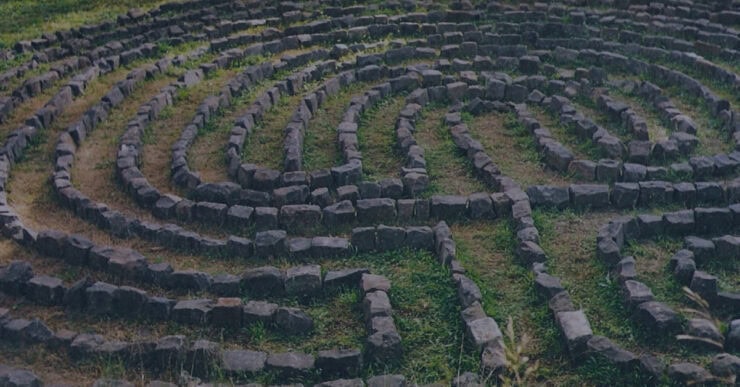
When one looks at a labyrinth it might seem like it would be similar to a maze however they are quite different in their purpose. While the intention of a maze is to be confounded by deadends, false turns and looping trails in the struggle to find the exit; a labyrinth is almost the opposite – one entrance, one path to the centre, and return. Those seeking a pilgrimage might visit temples, shrines, cathedrals, monasteries, and other sacred sites – the labyrinth allows for such sacred encounter and seeking of beauty, and there are more than 100 across Australia.
The intention of the creative and contemplative practice of walking a labyrinth is not to get somewhere, but rather you walk it to remember something. As you travel inwards, in your thoughts and within the circle, your focus leaves worldly cares, chronos tasks and urgency behind. This makes room for a moment of sacred encounter, and to remember – and be orientated towards – what the central and important tenets at the centre of your life are. The design of a labyrinth deliberately seems straightforward and direct but then is longer and more roundabout than you expect which can be a reflection of our life’s path.
In Waiting for God, Simone Weil writes of the experience of entering a labyrinth – loss, shedding, wayfinding and then the return to God, to self, to truth.
The beauty of the world is the mouth of a labyrinth.
The unwary individual who on entering takes a few steps
is soon unable to find the opening.
Worn out, with nothing to eat or drink, in the dark,
separated from her dear ones,
and from everything she loves and is accustomed to,
she walks on without knowing anything or hoping anything,
incapable even of discovering whether she is really going forward
or merely turning round on the same spot.
Many paths of life experience can bring us to these moments of disoreintation and confusion but when we remember the Creator is at the centre, we cannot stray to a wrong path. By having a facilitated way to traverse this liminal space we are able to use this interactive tool:
- to broaden our perspective and our teaching or ministry praxis
- to invite collective contemplative praxis – we know the pace of life and social media ‘feed’ are impacting humanitys’ capacity for, and time: to pause, to take a breath, to have quiet, silent reflection or moments of sacred Encounter and we must reclaim these rhythms
- to support our own wellbeing, resilience and capacity-building
In October, the University of Divinity is offering a facilitated labyrinth to members of its alumni network, an Invitation To Walk Together which will be a good opportunity for professional development for those in: RE teaching; clinical placements; undertaking pastoral, ministry or chaplaincy care roles; or those simply wanting to broaden and deepen their own contemplative knowledge and praxis. This will be a chance for University alumni to connect with one another, and also the new Dean of Teaching and Learning around intentional path setting for the future of the University.
The practice of walking a labyrinth can be self-led, you might like to discover a public labyrinth near you, or explore the possibilities of making a temporary one of your own using tips on how to lay one out. A labyrinth can be created with a variety of different materials for different contexts, seasons and weathers such as: drawn with a stick in sand at the beach, tealights in jars to light the path, drawn with chalk in a carpark or playground. Finger-labyrinths also make it possible to curate the experience for those with limited mobility making the practice very accessible.
The beauty of the world is the mouth of a labyrinth, let us walk together now.
Talitha Fraser is the Administration Officer at the Office of the Vice-Chancellor.

 Catholic Theological College
 Naomi Wolfe
 Jason Goroncy
 Rosemary Dewerse
Add comment