

 University of Divinity
An invitation from Working Group on Theology & Ethics of AI (Academic Board)
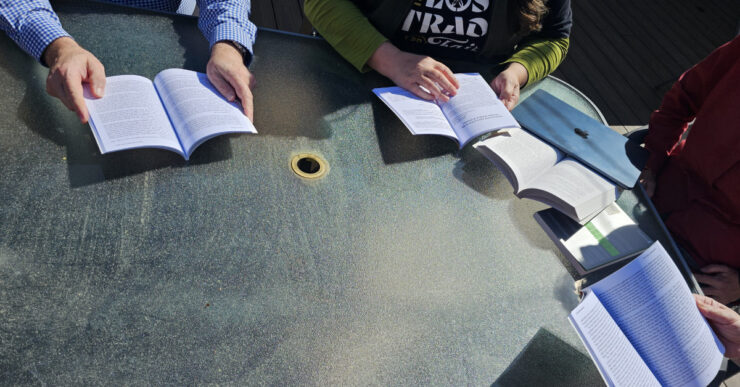
Curious to connect your theological expertise and insights with the thriving discussion about the new tools of GenAI? Interested in reflecting with colleagues on how the University of Divinity can become a model of best practice in decision-making about this technology? Here is an opportunity to join a short-term ‘book group’ that will meet three or four times between now and February 2027. They are designed to be a manageable way for ‘critical mass’ of students and staff to help inform UD policy on the ethical and spiritual choices that GenAI presents.
The circles are an initiative of the Academic Board’s Working Group on Theology and Ethics of AI. They are the next step in a process that produced the statement presented at the June 2026 Learning and Teaching Day. They will build on our strengths as a community of readers and thinkers. They are a deliberately slow and relational step so that we have a strong foundation of shared perspectives for the policy work and urgent practical decisions in this rapidly changing area. In February 2027 the Academic Board will review the draft statement alongside feedback from the book groups to further our resources for articulating the values that support our approach to AI.
If you are interested in joining a Reading Circle please complete the form below. This shared process of theological reflection is open to students, lecturers and researchers associated with all colleges and networks. Each group will focus on a key text from the list below. You can choose to meet with your college or a group of people from your discipline area, or with a more mixed group. There will be in person, online and hybrid options.
Expressions of interest close soon – on 14 September. There will be a briefing for facilitators and then the Reading Circles will launch from Tuesday 22 September.
The texts we are reading are:
Mark Graves, “Generative AI and Theology: A Three-Year Retrospective.” Theology and Science (2026) 24 (1): 1–7.
doi:10.1080/14746700.2025.2592326.
(A group of systematic theologians is ready to roll on this, with Simon Wayte)
Leo XIV, Magnifica Humanitas: On Safeguarding the Human Person in the Time of Artificial Intelligence, St Paul Publications, 2026.
Online and open access at: https://www.vatican.va/content/leo-xiv/en/encyclicals/documents/20260515-magnifica-humanitas.html
Sarah O’Connor, We Are Not Machines: The Fight For The Future of Work, Allen Lane, 2026.
(Released on 11 September 2026. One option to read this is with Cindy Derenbacker and Carlos Lopez at the Dalton McCaughey Library in Parkville, Melbourne. You will need a paper copy for this one.)
Beth Singler, Religion and Artificial Intelligence: An Introduction, Routledge, 2024.
Online and open access at: https://www.taylorfrancis.com/books/oa-mono/10.4324/9781003256113/religion-artificial-intelligence-beth-singler
(One option to read this is with Rebekah Pryor and Rohan Eadmes at St Paschal’s in Box Hill, Melbourne)
Robert Wright, The God Test: Artificial Intelligence and Our Coming Cosmic Reckoning, Simon and Shuster, 2026.
 Whitley College
Add comment