

 Religion and Social Policy
A Project of the Religion and Social Policy Network of the University in collaboration with the Victorian Council of Churches
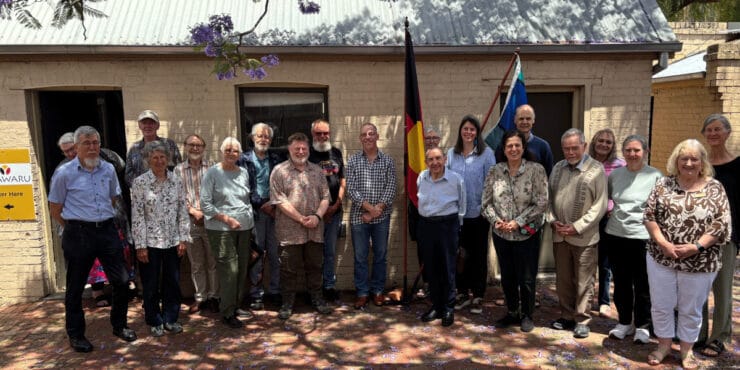
On 12 December 2025, the Victoria Treaty between the state of Victoria and First Peoples officially came into effect to great public celebration. The next day a much smaller group gathered at Yilawaru in St Kilda to consider and respond to the recent book Contemplating Country by Trawloolway theologian Rev Dr Garry Worete Deverell. The gathering was hosted by Wiradjuri artist and theologian Archdeacon Glenn Loughrey, who opened proceedings with a smoking ceremony and an acknowledgement of the Wurundjeri and Bunurong Countries on which we were meeting. Other Indigenous participants were Ms Sherry Balcombe (Olkola-Kunjen/Muluridji-Djabugay), Ms Naomi Wolfe (Trawloolway), and Dr Deverell himself. Each of the first three Indigenous participants served as consultant to one of the three small groups that discussed responses to Dr Deverell’s book, with papers presented by non-Indigenous writers Mersina Papantoniou, John Bottomley, Anne Elvey, Mick Pope, and Duncan Reid. The facilitators for the small groups were Mr Tim Molineux (social justice officer, Uniting Church), Rev Dr Gordon Preece (editor of Ethos), and Associate Professor Joanna Cruikshank (senior lecturer, Deakin University). The second half of the morning consisted in a panel discussion, with the four Indigenous participants constituting the panel, and chaired by Rev Sandy Boyce, General Secretary of the VCC.
The papers presented on the day are to be published by ATF Press early in the new year. Donations will be sought for a fund, announced by Dr Cruikshank, under the auspices of the Victorian Council of Churches to finance ongoing research by Dr Deverell, in the form of the third volume in his Gondwana Theology series. In his summing up, Dr Deverell pointed out that non-Indigenous theological allies came in two varieties (and sometimes both): ‘those who engage our work through both respectful listening and active intellectual response; and those who not only speak but also act to support our theological work.’ Theology may begin at dusk, as Gustavo Gutierrez told us more than fifty years ago, but if Indigenous theology is to be treated seriously as a legitimate theological enterprise, it must also be possible in broad daylight, not just after the day’s ‘real’ work of earning a living has been done.
All participants were asked to consider what they had heard and learnt from the conversation, and to tell someone else – by word of mouth, not just in writing – within the next day. The research has been done and will continue to be done; the conversation was a valuable instance of engagement between two theological cultures, Indigenous and non-Indigenous, at a decisive turning point for both communities in Victoria and more widely; and the impact is already shaping the way theology and social policy will be undertaken into the future.
Article by Duncan Reid
Secretary, RASP

 University of Divinity
 Guest Author

Add comment